


Best Mixer Grinder for Home: The Ultimate Buying Guide
Whether you're grinding spices, preparing chutneys, making dosa batter, blending smoothies, or creating everyday gravies, the right mixer grinder can save time and make cooking more convenient. However, with multiple wattage options, motor types, jar configurations, and features available, choosing the best mixer grinder for your home can often feel confusing.
Choosing the right mixer grinder is not about selecting the most powerful model available. It is about finding a mixer grinder that suits your cooking habits, household size, and everyday kitchen requirements. Factors such as motor power, RPM, jar quality, blade design, safety features, and ease of maintenance all play an important role in determining overall performance and long-term usability.
For most Indian households, the decision typically comes down to two practical options: 500 W and 750 W mixer grinders. Understanding how these two categories differ in terms of grinding performance, versatility, and suitability for various cooking applications can make the buying decision much simpler and more effective.
When Should You Choose a 500 W Mixer Grinder?
A 500 W mixer grinder is generally suitable for lighter kitchen tasks such as preparing:
- Chutneys
- Onion-tomato purees
- Ginger-garlic paste
- Smoothies and shakes
- Soft masalas
It works well for smaller households or kitchens where cooking requirements are relatively moderate. These mixer grinders are usually quieter, more compact, and consume less electricity, making them convenient for daily use. Anything below 500 W may struggle with tougher ingredients and continuous grinding, especially in Indian kitchens where hard spices and thick batters are commonly prepared.
When Should You Choose a 750 W Mixer Grinder?
A 750 W mixer grinder, on the other hand, is better suited for most Indian households and demanding cooking applications. It can comfortably handle:
- Dry spices
- Coconut grinding
- Dosa-idli batter
- Thick gravy preparation
- Larger quantities of ingredients
They offer faster grinding, better efficiency, and the ability to process tougher ingredients without putting excessive strain on the motor. For homes where cooking is frequent and varied, a 750 W mixer grinder usually provides the ideal balance between power and practicality.
What about 1000 W Mixer Grinders?
While 1000 W mixer grinders are available in the market, they are generally designed for specialised or heavy-duty grinding requirements rather than everyday household use. Although they offer higher power, they are also typically louder, heavier, bulkier, and more expensive.
For most Indian households, a high-quality 750 W mixer grinder provides sufficient power to handle common kitchen tasks such as grinding dry spices, preparing chutneys, processing coconut, and making dosa-idli batter. In most cases, a well-built 750 W mixer grinder is fully capable of handling everyday grinding and blending requirements efficiently.
Users who frequently process large quantities of ingredients, operate a home-based food business, or require extended grinding sessions may benefit from a 1000 W mixer grinder. Unless there is a very specific heavy-duty requirement, higher wattage often adds more power than most users need.
How Important Are Mixer Grinders' Jars and Blades?
Many buyers focus on motor wattage when choosing a mixer grinder, but the quality of the jars and blades is equally important for performance, durability, and ease of use.
Stainless steel jars are generally preferred over plastic alternatives because they are durable, hygienic, and easy to maintain. Features such as sturdy handles, secure lids, and transparent covers improve convenience and allow you to monitor the grinding process without interruption.
The blade system also plays a crucial role. Food-grade stainless steel blades with sharp, corrosion-resistant edges help deliver smoother grinding results and long-lasting performance, while a secure blade assembly ensures stability during operation.
How Many Jars Do You Really Need?
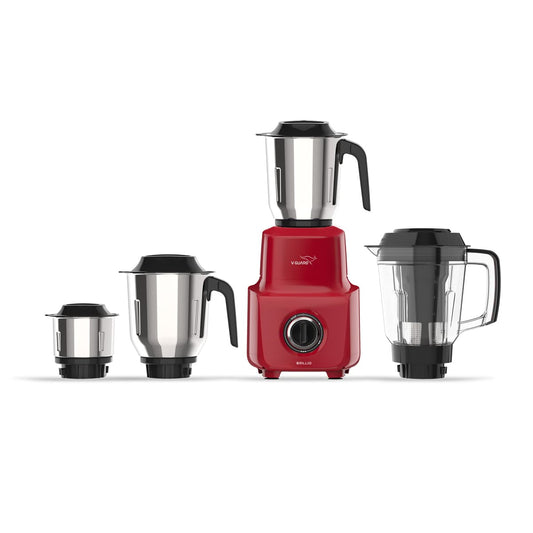
For most households, three essential jars are sufficient for everyday cooking:
- Small Jar: For chutneys and dry spices.
- Medium Jar: For masalas, purees, and gravies.
- Large Jar: For dosa-idli batter and larger portions.
Is a Juicer Jar Necessary?
A juicer jar is not essential for every household, but it can be a useful addition if you regularly prepare fresh juices, milkshakes, smoothies, cold coffee, etc.
Ultimately, a mixer grinder with high-quality jars and blades will often deliver better performance and reliability than one that simply includes a larger number of accessories.
500 W vs 750 W Mixer Grinder: Comparison Table
| Feature | 500 W Mixer Grinder | 750 W Mixer Grinder |
|---|---|---|
| Best For | Small families and basic cooking | Most Indian households and regular cooking |
| Ideal Tasks | Chutneys, purees, smoothies, soft masalas | Dry spices, coconut, batters, thick gravies |
| Grinding Performance | Suitable for light to moderate use | Handles tougher ingredients with ease |
| Speed & Efficiency | Moderate | Faster and more efficient |
| Noise Level | Generally quieter | Slightly louder |
| Recommended For | Occasional cooking needs | Frequent and versatile cooking requirements |
What are the different types of motors used in mixers and grinders?
Motor quality plays a major role in determining the long-term performance and durability of a mixer grinder.
- Aluminium motors are usually the most economical option and are suitable for basic or occasional use, but they typically offer lower durability and heat resistance.
- Copper motors are considered superior because they handle heat better, offer better efficiency, and are suitable for heavy-duty use. However, they are also more expensive and unnecessary for users who do not require frequent usage, such as in bakeries or cafes.
- Hybrid motors are designed to offer a middle ground by combining copper and aluminium components to deliver a balance of performance, efficiency, and affordability. These motors are optimised for regular everyday kitchen use.
Mixer grinders such as the V-Guard Citius 750 W use advanced hybrid motor technology to provide reliable daily grinding performance while maintaining practicality and value.
Ideal RPM for Mixer Grinder
Another important specification closely linked to motor performance is RPM (Rotations Per Minute), which indicates how fast the blades spin. Best mixer grinders operate between 18,000 and 22,000 RPM. Higher RPM generally enables faster grinding and smoother textures, but excessively high RPM can also generate more heat, affect flavour and aroma, and increase noise levels. This is why a balanced combination of motor quality and RPM is more important than simply choosing the highest wattage or RPM available.
Ease of Maintenance and Safety Features
Cleaning and maintenance are often overlooked during purchase decisions, even though they significantly impact everyday convenience. Mixer grinders with detachable blades and easy-to-clean surfaces are easier to maintain. Complex jar shapes may appear modern but can trap food particles and make cleaning difficult. Darker body colours such as black and blue also tend to be more practical for daily use, as they are better at concealing stains, fingerprints, and spice marks compared to lighter shades.
Regular cleaning immediately after use, drying the jars properly before storage, and avoiding overfilling during operation can help maintain both hygiene and long-term performance.
Modern features can also improve usability and safety. Features such as pulse mode, overload protection, anti-skid feet, and lid-lock systems add convenience and help protect the motor during operation.
Why Warranty and After-Sales Support Matter?
Warranty and after-sales support are equally important considerations. A good mixer grinder should ideally come with at least a 2-year product warranty, along with an extended warranty on the motor whenever possible. Nationwide service centres and easy availability of spare parts can make a significant difference in the long run, especially for an appliance that is used almost every day.
Small design details should not be ignored. A stable body, sturdy handles, properly locking lids, a smooth speed control knob, practical cord length, and easy jar handling all contribute to a better everyday experience. In many cases, thoughtful ergonomics and ease of use matter more than decorative styling or unnecessary features.
Final Verdict
Choose a 500 W Mixer Grinder if:
- You have a small household.
- Your grinding requirements are relatively light.
- You mainly prepare chutneys, purees, and shakes.
Choose a 750 W Mixer Grinder if:
- You cook regularly.
- You frequently grind spices and coconut.
- You prepare batters and larger quantities of ingredients.
Whether you prioritise power, convenience, or value, V-Guard's range of mixer grinders offers reliable options designed to suit a variety of cooking needs and household requirements.
Related Products


- Choosing a selection results in a full page refresh.
- Opens in a new window.