


The Complete Inverter & Battery Sizing Guide
Finding the perfect power backup doesn't have to feel like a high-school physics test. Here is a quick snapshot of the three-step formula we will use to keep your lights on and your electronics safe.
Why Sizing Matters
Power cuts are unpredictable, frustrating, and disruptive. Whether you're working from home, streaming your favourite series, or trying to sleep comfortably during a hot summer night, a reliable backup power source is no longer a luxury — it is an absolute necessity.
But when you start shopping for a home backup system, you're immediately bombarded with technical terms: VA, Watts, Ah, Pure Sine Wave, and Voltage. This guide explains each of these terms in simple language.
Buy too small and your backup will trip the moment you switch on one extra fan. Buy too large and you pay thousands of extra rupees for capacity you'll never use.
In this guide, we break the math into three simple steps using real-world examples, helping you find the perfect match from the V-Guard inverter and battery lineup.
Step 1 — Calculate Your Total Running Load (In Watts)
Before looking at any hardware, determine what appliances you want to run at the same time during a power cut. Here's a standard appliance power-consumption cheat sheet:
| Appliance | Power Consumption |
|---|---|
| LED Bulb / Tube Light | 15 W |
| Ceiling Fan | 75 W |
| Wi-Fi Router | 15 W |
| LED TV (up to 43") | 80 W |
| Laptop Charger | 90 W |
| Refrigerator (Inverter type)* | 200 W |
*Actual refrigerator power consumption varies significantly by capacity, compressor technology, and operating conditions.
Scenario A — The Essential Home Office / 1BHK
Running 3 ceiling fans, 4 LED lights, 1 Wi-Fi router, and 1 laptop charger.
(3 × 75W) + (4 × 15W) + (1 × 15W) + (1 × 90W) = 390 Watts
Scenario B — The Full Family Home / 2–3 BHK
Running 3 ceiling fans, 5 LED lights, 1 TV, 1 Wi-Fi router, and a refrigerator.
(3 × 75W) + (5 × 15W) + (1 × 80W) + (1 × 15W) + (1 × 200W) = 595 Watts
Step 2 — Choose Your Inverter Capacity (The VA Rating)
Inverters are rated in VA (Volt-Ampere) — apparent power — while appliances are rated in Watts (W) — real power. The gap between the two is the Power Factor (PF): the share of apparent power actually delivered as usable real power, which drops when a load has motors or compressors (fans, fridges) that shift the current out of phase with the voltage. Most home inverter manufacturers use a power factor assumption of approximately 0.8 for sizing calculations.
On top of that, add a 25% safety cushion so the inverter never runs at 100% capacity — this also absorbs the brief startup surge of motor-driven appliances.
Required VA = (Total Load in Watts × 1.25) ÷ 0.8
Quick Lookup: Household Wattage vs. Recommended V-Guard Inverters
| Your Total Load | Required VA Range | Recommended V-Guard Inverter | Best Suited For |
|---|---|---|---|
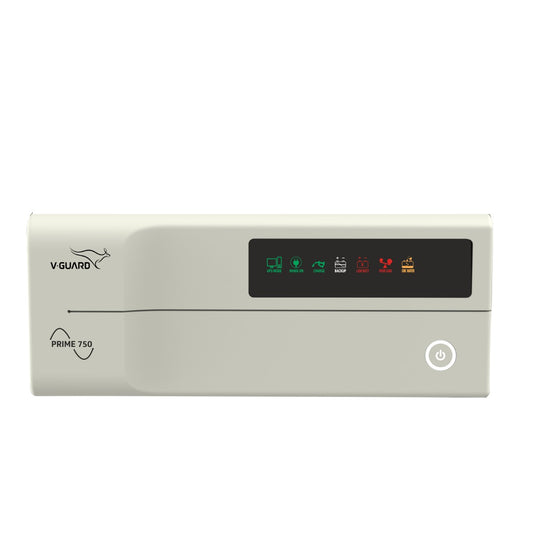
| 0 – 416 W | Up to 650 VA | Prime 750 MiLi (650 VA / 520 W) | 1BHK apartments, study rooms, small home offices |
| 417 – 496 W | 651 – 775 VA | Aviolux 800 (775 VA / 625 W) | 1–2 BHK homes running essential fans, lights, and a TV |
| 497 – 608 W | 776 – 950 VA | Aviolux 1100 (950 VA / 760 W) | 2 BHK homes with heavier light & fan requirements |
| 609 – 640 W | 951 – 1000 VA | Prime 1150 (1000 VA / 800 W) or Smart Pro 1200 (1000 VA / 800 W)* | 2–3 BHK homes needing standard or premium heavy-duty backup |
*The Smart Pro 1200 additionally features built-in Bluetooth connectivity for real-time mobile app monitoring and a Pure Sine Wave output, meaning the electricity it produces is as clean and stable as grid power, which protects sensitive electronics like laptops, routers, and smart TVs from the choppy waveform of cheaper inverters.
A note most guides skip: Starting Surge. Running-watt figures like these tell only half the story. Motor-driven appliances — refrigerators, water pumps, mixer grinders — briefly draw 2–3× their running wattage the instant they switch on. The 25% safety cushion in Step 2 comfortably absorbs a single such surge, but if a fridge and another motor load are likely to start together, size one tier higher for headroom.
Matching Our Two Scenarios
Scenario A (390 W Load): Required VA = (390 × 1.25) ÷ 0.8 = 609.38 VA. The Prime 750 MiLi (650 VA) is the direct match, with the Aviolux 800 (775 VA) as an optional upgrade for extra headroom.
Scenario B (595 W Load): Required VA = (595 × 1.25) ÷ 0.8 = 929.69 VA. The Aviolux 1100 (950 VA) is the direct match. For futureproofing against added appliances, step up to the Prime 1150 or the premium Smart Pro 1200 (both 1000 VA).
Step 3 — Choose Your Battery Capacity (The Ah Rating)
If the inverter is your system's engine, the battery is the fuel tank. Battery capacity is measured in Ah (Ampere-Hour) — this number dictates exactly how many hours of continuous backup power you'll get.
Battery Capacity (Ah) = (Total Load in Watts × Desired Backup Hours) ÷ Battery Voltage (12V)
For simplicity, this guide uses a theoretical calculation. In real-world applications, factors such as inverter efficiency and battery reserve capacity should also be considered.
Let's assume you want 4 hours of reliable, uninterrupted backup.
Matching Scenarios to Our Battery Lineup
| Battery Model | Capacity | Max Load for 4-Hour Backup | Best Suited For |
|---|---|---|---|
| VJ 145 | 135 Ah | ≈ 405 W | Compact apartments / budget-focused setups |
| VT 160 P | 152 Ah | ≈ 456 W | Balanced home office / medium backup |
| VT 165S | 154 Ah | ≈ 462 W | Long-lasting standard performance |
| VT 170 DLX | 155 Ah | ≈ 465 W | High-durability luxury backup |
| VT 220 | 205 Ah | ≈ 615 W | Heavy loads / extended, frequent cuts |
| VT 250 DLX | 230 Ah | ≈ 690 W | Ultimate peace-of-mind backup |
The third column is a quick reference for any load, not just our two scenarios — it shows the heaviest continuous load each battery can sustain for a full 4-hour backup.
Scenario A (390 W for 4 Hours): Required Ah = (390 × 4) ÷ 12 = 130 Ah. The VJ 145 (135 Ah) is highly cost-effective here. For a more comfortable margin, the VT 160 P (152 Ah) or VT 165S (154 Ah) works brilliantly.
Scenario B (595 W for 4 Hours): Required Ah = (595 × 4) ÷ 12 = 198.33 Ah. Running heavy continuous loads requires strong stamina — the perfect match is the VT 220 (205 Ah), or the premium VT 250 DLX (230 Ah) for optimal system buffer.
Note: The calculations in this guide are intended for estimation purposes. Actual inverter and battery requirements may vary based on appliance specifications, startup surge loads, inverter efficiency, battery condition, and usage patterns. For the most accurate recommendation, consult a V-Guard expert or authorised dealer.
Why an Inverter-Battery "Combo" Beats DIY Pairing?
Many homeowners make the mistake of buying an inverter from one brand and a battery from another to save a little cash. Here is why that "DIY shortcut" can become a costly compromise:
1. Mismatched Charging Profiles
Batteries need fine-tuned multi-stage charging algorithms. If your inverter's charging profile isn't calibrated perfectly to the battery's specific chemistry, it will constantly undercharge (yielding poor backup times) or overcharge (causing water boil-off, acid degradation, and dramatically shortening battery lifespan).
2. No Unified Warranty Window
If a mismatched backup system fails, the inverter brand blames the battery and the battery brand blames the inverter — leaving you to cover the bill.
3. Engineered System Synergy
Our factory-engineered, pre-configured Inverter-Battery Combos are certified to run in perfect synchronisation. This structural synergy optimises backup efficiency, cuts power wastage, and helps optimise charging performance and may contribute to improved battery longevity when compared with poorly matched inverter-battery combinations.
Need Help Choosing the Right Inverter and Battery?
Choosing the right backup solution doesn't have to be complicated. If you're unsure about the ideal inverter and battery combination for your home, explore V-Guard's range of home power solutions or connect with a V-Guard expert for personalised guidance based on your power requirements and backup needs.
Related Products


- Choosing a selection results in a full page refresh.
- Opens in a new window.